
6 Community Initiatives That Are Actually Bridging Political Polarization
On a cloudy fall afternoon in Anaheim Hills, California, a community organizer named Lorena stood on the porch of a skeptical retiree who had warily opened his door. Instead of launching into a political pitch, she asked one question: “How has all this polarization touched your life?”
The man exhaled. Then slowly started talking about a family member he hadn’t spoken to since 2020. About avoiding neighborhood gatherings. About how his world had quietly gotten smaller.
Thirty minutes later, he asked Lorena to come back. “This gives me faith in humanity,” he told her. “You weren’t here to sell anything and I feel less alone.” Pew Research Center
That exchange captures something researchers and organizers across America are increasingly documenting: empathy, practiced at the community level, is one of the most powerful antidotes to polarization we have. And it’s already working.
Why Community Bridging Works Where National Politics Fails
National political discourse is engineered for conflict. It rewards outrage and punishes nuance. Community life operates differently. Neighbors share schools, roads, and the daily texture of living near each other. Those shared stakes create natural openings for connection that political discourse actively destroys.
Research shows that building the skills to navigate differences starts with giving people opportunities to engage meaningfully in solving real-world problems at the center of their daily lives. Making it too easy for people to get involved paradoxically makes it too easy for them to leave when conflict or difference arises.
Genuine bridging requires genuine investment. The six initiatives below all understand this.
1. Bridging for Democracy: 26,000 Doors and a New Model of Canvassing
In fall 2024, a coalition of grassroots organizations coordinated by UC Berkeley’s Othering and Belonging Institute launched one of the most ambitious bridging experiments in recent American history. Instead of knocking on doors to persuade people how to vote, canvassers were trained to do something far more difficult: listen.
Bridging for Democracy groups knocked on over 26,000 doors and held nearly 2,350 deep conversations across six states. Three-quarters of residents said they would welcome canvassers back. Pew Research Center
The core question canvassers were trained to ask wasn’t about policy. It was: “What do you need to be okay today?” That shift alone transformed how residents responded.
OBI Program Director Olivia Araiza described the philosophy: “Bridging isn’t a distraction from social justice work. It is a strategy to get us to a bigger we.”
This transformation highlights a core political reality: A person who feels truly listened to will often vote for you even if they disagree with some of your positions. They are choosing to trust your character over a list of policies. In the world of high-stakes campaigning, this “listening first” approach is what turns a cold contact into a long-term supporter.
2. Braver Angels: Structured Dialogue Across the Red-Blue Divide
Founded after the 2016 election, Braver Angels brings together roughly equal numbers of conservatives and liberals for structured, facilitated workshops specifically designed to reduce hostility, not reach agreement.
Participants describe their own views, steelman the other side’s perspective, and explore the personal experiences that shaped their beliefs. The results are measurable: participants consistently show reduced hostility and increased belief in the possibility of productive cross-partisan conversation. Braver Angels now operates in all 50 states.
What distinguishes it from casual dialogue is its insistence on structure. Ground rules are explicit, facilitation is trained, and the goal is never policy agreement, it is mutual recognition of the human beings behind the positions.
3. Make the Road Nevada: Bridging in Elko
Make the Road Nevada drove six hours over the mountains to Elko, a rural conservative town where their previous outreach had been nonexistent. When canvassers arrived, residents called the police on them. After negotiating with officers for permission cards, they kept knocking. “We have more in common with these folks than I thought,” one canvasser admitted after conversations about wages, healthcare, and family.
Out of that work, the organization hired its first rural outreach manager and established community hubs in two previously unreached Nevada towns. More than 300 residents participated in community assessments who had never engaged with a civic organization before.
“Belonging isn’t a soft feeling. It’s a hard practice,” said Deputy Director Blanca Macias. “It’s listening sessions in Elko, pozole dinners in Wendover.”
4. Essential Partners: Dialogue That Measurably Reduces Hostility
Essential Partners, formerly the Public Conversations Project, has been facilitating structured dialogue across deep divisions since 1989, beginning with abortion rights advocates and pro-life activists in Boston who considered each other morally dangerous.
Their multi-decade research shows something counterintuitive: you don’t need agreement to reduce hostility. You need contact of the right kind, contact involving personal storytelling, genuine listening, and explicit acknowledgment of the other person’s humanity. Their model has since been applied in Northern Ireland, Israeli-Palestinian dialogue, and deeply polarized American communities, consistently producing measurable reductions in affective polarization.
5. MOSES and the Livonia Congregations: Bridging in a Sundown Town
Livonia was long known as a sundown town. MOSES Executive Director Ponsella Hardaway described beginning bridging work there as historic: “My own brother, as a young man, had to pass through for work and lived with that fear.”
MOSES facilitated café-style dialogue sessions with four all-white congregations in Livonia. Participants arrived skeptical and guarded. By the end, the atmosphere had shifted. One participant admitted: “I had all of you pegged. I was wrong.” Pew Research Center
What made this work wasn’t a feel-good agenda. It was a willingness to begin in a genuinely hard place, with honest acknowledgment of the history that made the room difficult.
6. The Change Collective: Solving Problems Together
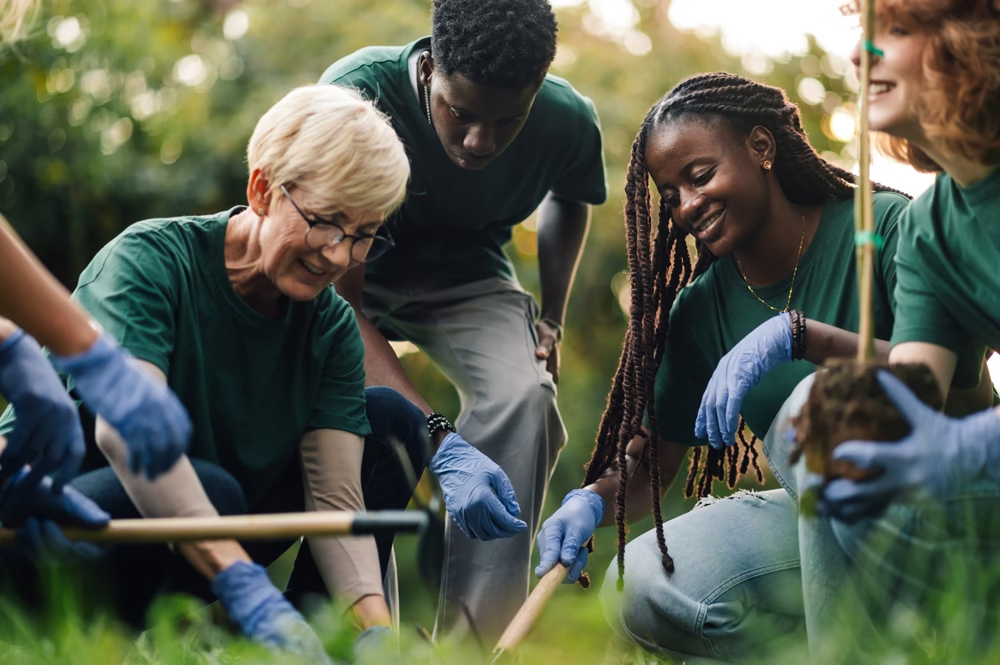
The Change Collective focuses on developing local leaders across the country. By bringing people together to solve problems at the community level, the program works to increase civic participation and make communities more resistant to polarization, disconnection, and distrust.
Participants spend six months developing civic action plans with real local impact. In Detroit, one member created a collaborative space for women of color artists. In Jackson, Mississippi, another launched free expungement services for young adults with prior convictions, connecting them with employers committed to hiring them.
The insight is powerful: when people from different backgrounds work together on a shared concrete problem, the differences that feel insurmountable in the abstract become manageable in practice.
What All 6 Have in Common
Every initiative that measurably reduces polarization shares four features: they start with listening rather than persuading, create structured conditions for honest sharing, focus on human experience rather than policy positions, and sustain the work over time.
As OBI Director John A. Powell put it: “Bridging is not a cure-all. But it is an inoculation. When residents who disagree politically have felt truly heard by one another, it becomes harder for demagogues to convince them that democracy is a zero-sum fight.”
Democracy Is a Local Practice
The polarization we see nationally is real. But so is the bridging work happening in Anaheim Hills, Elko, and Livonia. The gap between those two realities isn’t just media distortion. It is a genuine feature of how change works.
National politics moves through conflict and crisis. Communities move through conversation, relationship, and the slow construction of trust. Both are real. But only one is something ordinary citizens can actually do tomorrow morning.
The retiree in Anaheim who told Lorena that her visit gave him faith in humanity wasn’t describing a political conversion. He was describing something more durable: the rediscovery that the person on the other side of the door is a person. That is where depolarization actually begins.
Explore more: The Intersection of Active Listening and Policy Change and Advanced Communication Strategies for Political Engagement.
Frequently Asked Questions
A nonprofit that facilitates dialogue and builds relationships across political or social divides. Examples include Braver Angels, Essential Partners, and the Bridge Alliance.
A coalition of over 100 organizations working to strengthen American democracy, connecting bridging groups across the political spectrum with shared resources and research.
A nonpartisan student organization founded at UC Berkeley that facilitates cross-partisan dialogue on campuses, now active at universities across the country.
A framework focused on rebuilding civic and social infrastructure at the community level, emphasizing local engagement and cross-sector collaboration as foundations of healthy democracy.
Start with listening, create explicit structure and ground rules, focus on personal stories over policy, and sustain relationships over time rather than relying on one-off events.